
Scottish Special
Books and history beyond the capital

Under steely skies and drizzle (a truly Scottish summer), I spent a few days last week discovering Scotland’s history beyond its capital city. Although my husband and I stayed in Edinburgh, it was our adventures slightly further afield that left the greatest impression.
Stirling Castle
Just under an hour from Edinburgh is Stirling. Stirling is known for its castle, where Mary Queen of Scots lived and where her son, James V (later James I of England), was born. Originally built in the 12th century, the castle adopted a more Renaissance-style look under monarchs such as James IV and James V.
From its imposing walls, including a great spot known as the ‘ladies’ lookout’, I gazed over a breathtaking landscape rich with memory. High on the hill stands the National Wallace Monument, marking the site where William Wallace led his troops to victory in the Battle of Stirling Bridge. In the distance is the site of the 1314 Battle of Bannockburn, where King Robert the Bruce defeated Edward II.
Inside its walls is the famous ‘gold’ hall, the oldest medieval hall in Scotland, which was home to fantastic feasts and celebrations. The light and airy Chapel Royal with its 17th-century friezes was where Prince Henry was baptised. And the intricate 16th-century ceiling carvings of queens, kings and emperors are on display in the Stirling Heads exhibition.
Down the hill via a steep cobbled street is the Church of the Holy Rude, where James VI was crowned at 13 months old. It was a spine-tingling moment to stand on the spot where Scottish history was made.


Dunfermline
Across the famous Forth Bridge, a feat of Victorian engineering, is Dunfermline. Once the de facto capital of Scotland, it’s now the resting place of King Robert the Bruce and Saint Margaret.
Dunfermline Abbey has been a place of worship since 1070, originally founded by Queen Margaret and King Malcolm III. Its Romanesque nave is the oldest part of the abbey, with twisting, intricate columns and immaculately preserved doorways. Underfoot through glass panels, I glimpsed the remains of the 11th-century site. With the light spilling in from the Victorian windows, and a reconstructed head of Robert the Bruce watching over me, it was a surreal moment.
In the newer part of the church is the Victorian brass plaque that covers Robert’s tomb. His original monument was destroyed in the Reformation, and his remains lay undiscovered until 1888. Once again, I was standing on a site where history collided with the present.
And that’s not all there is. The abbey shares its grounds with Dunfermline Palace, once a monastic guest house turned into a royal residence. Gifted by James VI to his wife Anna of Denmark, it is where Charles I was born in 1600. He was the last British monarch to be born on Scottish soil.
The best part of this was that this was a spontaneous trip, inspired by my husband seeing an advert for Dunfermline. Had it not been that, this small city with its royal mausoleum would have completely passed us by.


A Scottish read
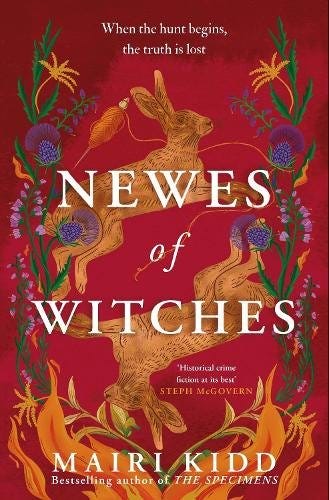
My book on location for this holiday was Mari Kidd’s latest book, Newes of Witches, out today. Although set in 17th-century rural Scotland, it’s easy to get a sense of the atmosphere of this one, especially when experiencing the landscape from the walls of Stirling and whizzing through on the train, and of what went on in the smaller communities beyond the big cities.
Set in rural Scotland in 1629 during the Scottish witch trials, Newes of Witches follows midwife Mòrag as she investigates missing children and witchcraft accusations in a paranoid village, risking everything to save an innocent girl from superstition and witch hunts.
This one is powerful, atmospheric, and claustrophobic. Set during a frenzied period of Scottish history under Charles I, it explores the relationships between communities and the power of superstition and belief. Isolation is also a key theme between individuals and against a rugged, remote landscape.
It’s also a story of women coming together across social classes, where wealth and power offer no protection against superstitious beliefs. It is a read that stirred anger about the treatment of women and the irrationality and susceptibility of humans. Yet, there was also admiration for how the female characters teamed up to survive, and how they fought for the best outcomes.
Paying homage to Scottish traditions, regional cuisine like bannocks, and authentic dialect (such as ‘o m’edail’), Kidd immersively captures Scotland’s history, heritage and identity.
This is a powerful and enlightening book. From stirring deep emotions combined with its intimate look at 17th-century Scotland, this one has lingered with me beyond Scotland’s borders.
Beautiful. I really want to get to Scotland at some point. A noble lineage with amazing history. Two of my all time favorite writers were Scottish, Sir Walter Scott and Robert Louis Stevenson.